

The trade show follow-up routine that runs without you
Deals don't slip away at the booth — they slip away in the gap between the show and the follow-up. A routine that mostly runs itself, built on process instead of willpower.
Cardexio Team
You worked the floor for three days. You came back with a stack of cards, a few conversations that actually went somewhere, and the quiet sense that something will come of it.
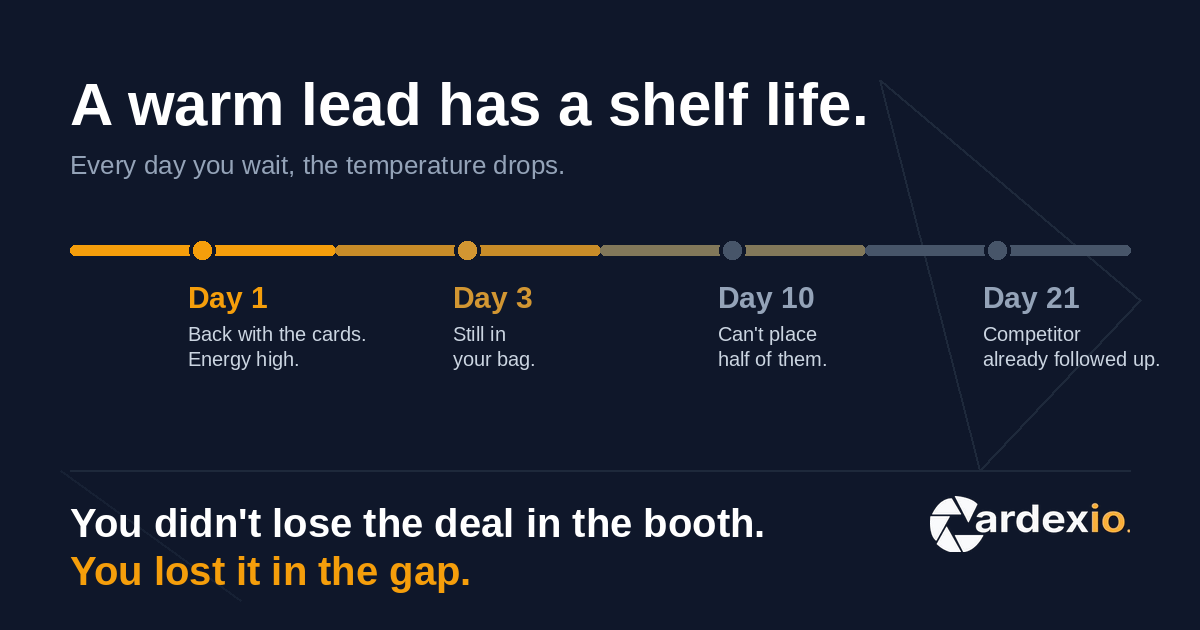
Then the week swallows you. The cards sit in a drawer. By the time you get to them, the warm ones have gone cold — and the people you genuinely clicked with have already heard from a competitor.
The deal didn't slip away at the booth. It slipped away in the gap between the show and the follow-up. This guide is about closing that gap with a routine that mostly runs itself, so the result doesn't depend on how much energy you have left when you get home.
Why most show leads never get a reply
It's rarely a motivation problem. Reps come back wanting to follow up. The routine breaks for boring, structural reasons:
- •The volume hits all at once. A good show produces more leads in three days than a normal month, and they all land on the same overloaded desk.
- •There's no system, just a pile. A stack of cards isn't a workflow. Without a place for them to go, they wait — and waiting is where leads die.
- •The context fades fast. The card tells you a name and a title. It doesn't tell you that this person runs procurement, asked about pricing, and wanted a call the following week. That lives in your head, and your head is full.
- •Manual entry is the bottleneck. Typing cards into a CRM one by one is the kind of task that always loses to something more urgent.
Fix the structure and the follow-up takes care of itself.
Capture context, don't just collect cards
The single highest-leverage habit is logging why a lead matters while it's still fresh — ideally at the booth, at worst the same evening.
A card plus thirty seconds of context beats a perfect card with nothing attached. For each person worth chasing, capture:
- •What they actually wanted (a demo, a price, an intro to someone else)
- •How warm they were (ready to buy vs. politely curious)
- •Anything time-sensitive ("call me after the 15th", "we're switching vendors this quarter")
This is the difference between a generic "great to meet you" email and one that opens with the exact thing they cared about. The second one gets replies.
The follow-up routine in three stages
A routine works because it's the same every time. Three stages, each with a clear trigger.
Stage 1 — Same day: triage
Before anything else, sort the pile into three buckets:
- 22Hot — asked for something specific, wants a next step. These get a personal reply first.
- 23Warm — real interest, no urgency. These enter a normal nurture cadence.
- 24Cold — collected a card out of politeness. These go into your list, no individual effort.
Triage on day one even if you don't send a single email yet. Sorting is fast; deciding case by case later is what kills momentum.
Stage 2 — Within 48 hours: the first real touch
The first 48 hours are when the show is still a shared memory. After that, you're a stranger emailing out of the blue.
For hot and warm leads, the first touch should:
- •Reference the specific conversation, not the event in general
- •Deliver the one thing they asked for, or a clear date for it
- •Make the next step small and obvious — a 15-minute call, a link, a single question
Keep it short. A three-line email that lands in two days beats a polished one that lands in two weeks.
Stage 3 — The next two weeks: cadence, not chasing
Most replies don't come on the first message — but most reps stop after it. The gap between "followed up once" and "followed up properly" is a simple cadence:
- •A second touch a few days later, adding something useful rather than just "checking in"
- •A third touch the following week, with a soft close or a clear way to opt out
- •Then stop. A clean exit respects their time and keeps the door open.
Cadence isn't chasing. It's showing up a predictable number of times with something to say, then moving on.
Take the manual work out of the routine
Everything above falls apart at one point: getting leads out of your pocket and into a system without an evening of typing.
This is the part to automate, because it's the part that reliably doesn't happen. The goal is a path from a physical card to a CRM record — with the context attached — in seconds rather than as a data-entry chore later.
That's the gap Cardexio is built to close. You scan a card on the show floor, add the context while the conversation is fresh, and it syncs straight into your CRM, so by the time you're home the triage is half done. The routine above stops depending on willpower and starts depending on a process — which is the only kind of follow-up that survives a busy quarter.
A weekly rhythm you can actually keep
You don't need a complex system. You need one recurring slot:
- •During the show: scan and tag as you go. Capture beats memory.
- •The evening after each day: five minutes to triage that day's leads.
- •48 hours after the show: first touches sent to hot and warm leads.
- •One weekly slot for two weeks: work the cadence, then close it out.
Block that weekly slot in your calendar like a meeting. The reps who win the post-show race aren't working harder than you — they've just removed the friction that makes follow-up optional.
You didn't lose the deal in the booth. Make sure you don't lose it in the gap.